Switch to LED bulbs
The single highest-return swap for most homes still using older bulbs.
- Cost
- $2–5 per bulb
- Saves
- Up to ~75–80% of lighting energy vs. incandescent
2026 Investigation
The ads say plug in one small box and watch your electric bill drop by half. We read the claims, looked at what is inside devices like it, checked the physics, and did the math — so you don’t have to spend the money to find out.
Our score
1.5/10
Not recommended
No — StopWatt will not meaningfully lower a typical home electric bill. Your meter charges for real energy used by your appliances, and a box in a spare socket cannot reduce that. For most buyers, it is a waste of money.
Compact, plug-and-play, harmless if certified
Advertised savings contradict how homes are billed
No independent, verifiable test data
Encourages buying multiple units for “whole-home” cover
Fact check
These are the claims that appear again and again in StopWatt-style advertising, paraphrased, with what the evidence says.
“Cuts your electricity bill by up to 90%.”
A plug-in box cannot change how many kilowatt-hours your fridge, heater or AC consume. Those appliances draw what they draw; a device in a separate socket has no control over them.
False“Stabilises current and removes dirty electricity.”
“Dirty electricity” is a marketing term, not a billing category. Grid voltage is already regulated by your utility, and a single small capacitor cannot meaningfully filter a whole home.
Misleading“Uses power-factor correction like big factories do.”
Industrial customers can be billed for reactive power, so correction saves them money. Typical residential meters bill real power (kWh) only — improving power factor at one socket does not lower that number.
Misleading“Just plug it in — no installation needed.”
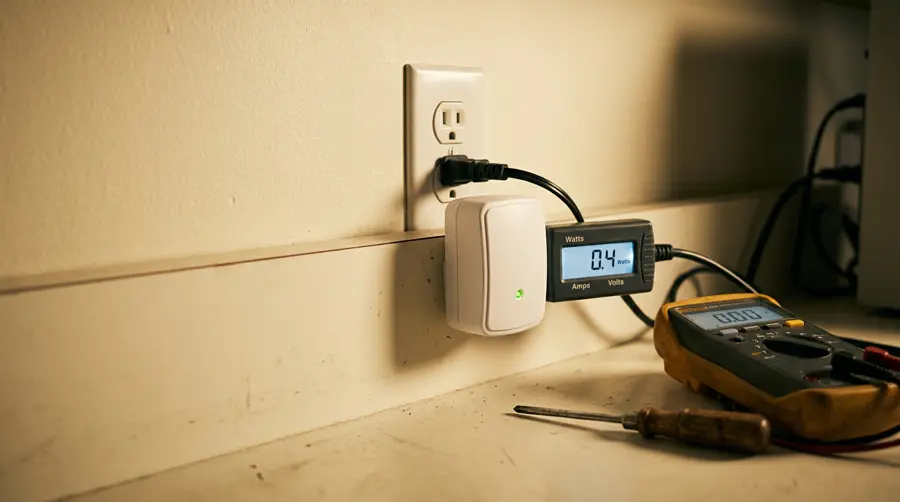
True, and that is the problem: a device that does nothing also needs no installation. The green LED proves it has power, not that it saves any.
True, but irrelevant“Protects appliances from power surges.”
Without a rated surge-protection component (MOV with a joule rating and UL 1449 listing), there is no basis for this. A proper surge strip is cheap and clearly labelled.
UnsupportedTeardown
Engineers who have opened plug-in “power savers” sold under many different names keep finding the same handful of parts. None of them can reduce what your appliances consume.
Capacitor
Usually the only “working” part. Shifts a tiny amount of reactive current at the socket it sits in.
Status LED
Glows when plugged in. Signals power, not savings.
Resistor + small board
Drives the LED and bleeds the capacitor. Adds its own small draw.
Empty space
Teardowns of near-identical “power saver” plugs often find the case is mostly hollow.
The physics in 60 seconds
Residential meters charge for real power used over time. That number is set by your appliances, not by anything sitting in another socket.
Reactive power — the thing a capacitor nudges — is billed to some industrial customers, but typically not to households.
The LED and resistor draw a small, constant amount of energy. In the strictest sense, it adds to your usage rather than subtracting.
Energy (kWh) = Real power (W) × Time (h) ÷ 1000. Nothing in that equation is changed by a capacitor in a spare outlet.
Interactive
Plug in your bill and what you paid. We compare the advertised saving with a deliberately generous real-world ceiling.
Ads for plug-in savers commonly quote anywhere from 30% to 90%.
Yearly savings
You spend
$98.00
Payback, as advertised
1 months
Payback, in reality
5.4 years
Even granting a 1% saving — more than independent measurements of similar devices tend to show — 2 units take 5.4 years to pay for themselves. The same $98.00 spent on LED bulbs or a smart power strip typically pays back within a year.
Better buys
Typical figures from public energy-efficiency guidance. Your results depend on your home, climate and habits — but every one of these changes what your meter counts.
The single highest-return swap for most homes still using older bulbs.
Standby draw can be 5–10% of home use. Unlike StopWatt, this actually switches things off.
Heating and cooling are usually the biggest line on the bill.
Weatherstripping and caulk around doors and windows pay back fast.
Zero cost, measurable on your bill.
Ironically, the best “energy gadget” is one that measures — not one that claims.
Reader questions
The questions people ask most before — and after — buying one.
Final verdict
If you want a lower electric bill in 2026, skip the miracle box. Put the money toward LED bulbs, a smart power strip or a few rolls of weatherstripping — boring, proven, and measurable on next month’s statement.
See what works instead